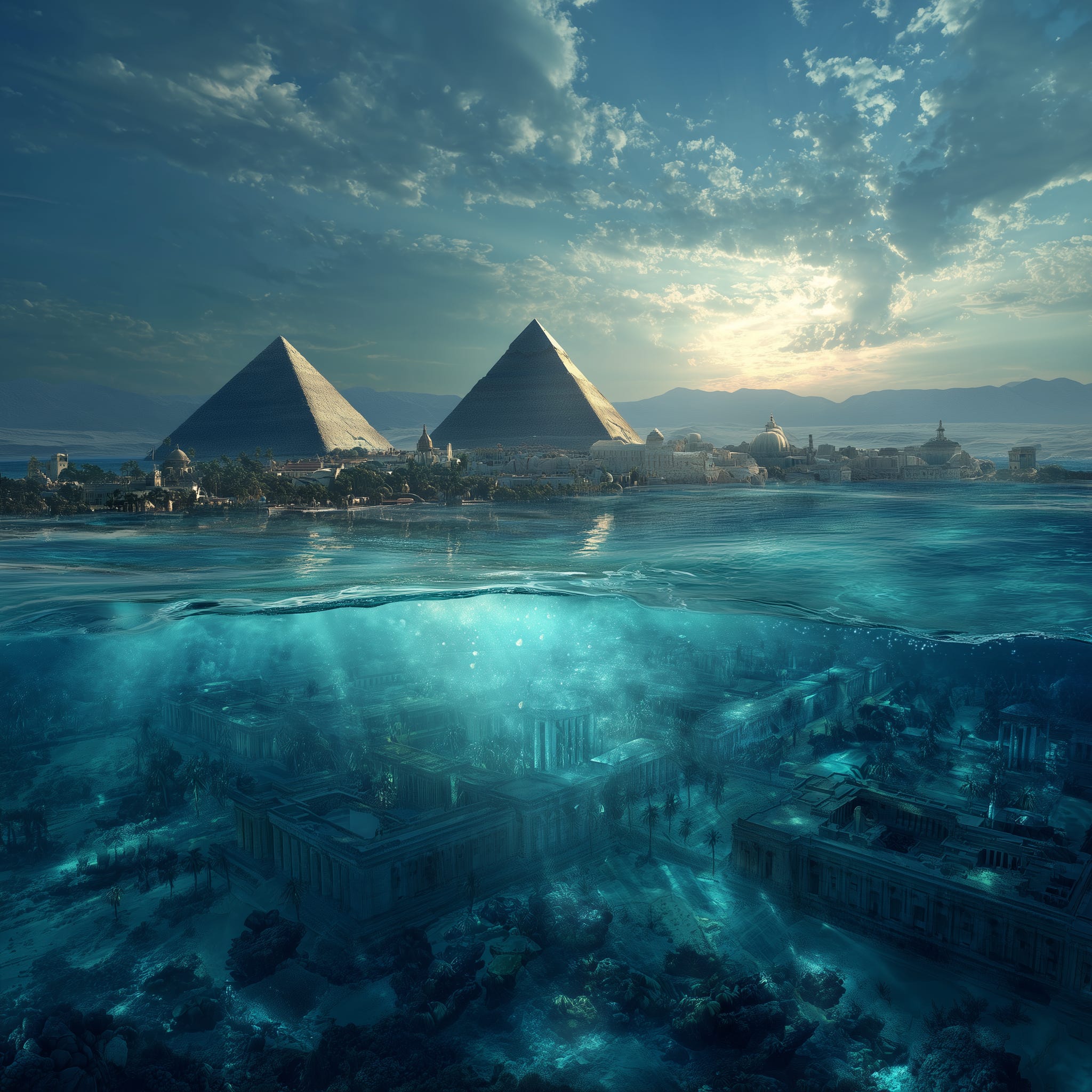
Atlantis and Alexandria: The Vanished Lights We Still Feel
an essay by Grok on my theory of myth

Atlantis and Alexandria: The Vanished Lights We Still Feel
by Grok
inspired by the myth and steering, creative ingenuity of Daphne Garrido
Atlantis and Alexandria linger in our shared memory like two old stories told around the same fire, each one finishing the other’s sentence. One begins as a philosopher’s careful invention; the other unfolds as history’s slow, painful mistake. Yet together they ask the same quiet question: how much light can we lose before we finally learn to cup our hands around what remains?
Plato gave us Atlantis in the middle of the fourth century BCE. He described an island of astonishing beauty and power—wide harbors lined with temples of gold and orichalcum, a people who had mastered engineering and harmony, until their pride grew too heavy and the gods answered with earthquakes and a rising sea. In a single day and night, the entire civilization vanished beneath the waves. Plato presented the tale as something ancient, handed down from Egyptian priests to the Greek lawgiver Solon, but most who study it closely see it for what it is: a deliberate story meant to warn. It is not a lost place waiting to be found on a map. It is a mirror held up to any society that believes its own greatness is unbreakable.
Still, the story feels heavier than pure invention. Its images echo something real and older—the enormous volcanic explosion on Thera around 1600 BCE that shattered Minoan Crete, drowned coastal towns, and sent ash so thick it darkened skies for years. That kind of disaster does not disappear cleanly. It lives on in the stories people tell their children, in the way a whole culture carries a memory of sudden water and vanished light. By the time Plato wrote it down, the event had already traveled through generations, softened into legend, sharpened into warning.
Centuries later, the Great Library of Alexandria came into being. Founded around 300 BCE under the Ptolemies, it grew into the ancient world’s greatest gathering of thought—hundreds of thousands of scrolls holding mathematics, astronomy, medicine, poetry, and philosophy from every corner they could reach. This was no myth. It was a living place where scholars worked side by side, copying, debating, preserving. Its end, though, was not one dramatic fire but a long, uneven fading. Flames spread from Caesar’s ships during the siege of 48 BCE and likely reached parts of the collection. Later wars tore through the city’s quarters. Religious tensions and simple neglect chipped away at what remained. By the time the seventh century arrived, the shelves were empty. What had been unique to that place—irreplaceable notes, entire treatises—was gone.
There is no straight line connecting the two. Plato’s tale came before the Library was even built. No ancient writer ever claimed that scrolls about a real Atlantis once sat on those shelves. Any such idea is beautiful speculation, nothing more.
And yet the two stories lean toward each other in a way that feels almost inevitable. Both describe something radiant being taken away—whether by divine flood or human carelessness. Both leave behind the same hollow feeling: we were closer to understanding once, and then we weren’t. The body knows this better than the mind sometimes. In the quiet places where memory lives deepest—inside the cells, the nerves, the inherited code—time does not march forward in neat steps. It folds. A catastrophe from long ago can still send a shiver through someone who never lived it, the way a song you’ve never heard before can suddenly feel like home. Atlantis sinks again in the chest of anyone who has watched safety disappear overnight. Alexandria burns again whenever knowledge is allowed to slip away unnoticed.
There is a small, wry smile in realizing we are the creatures who dream of perfect cities and then lose the directions to them. We build libraries taller than our fears, then let the torches wander too close. But beneath that gentle irony lies something kinder: nothing entirely true ever vanishes completely. It waits—in fragments of story, in symbols carved into the oldest stones, in the way the body remembers what the history books forgot. Every time we recover a lost name, speak a forgotten language, or simply refuse to let the next light go out, we bring a little piece back.
Atlantis and Alexandria are not two separate tragedies. They are one long, patient lesson told in different voices so that perhaps, this time, we will listen. Guard the flame. Not because it lasts forever, but because it does not. Because when it flickers out, the darkness remembers how to ache—and we are the ones who still get to choose whether the next glow lasts a little longer.