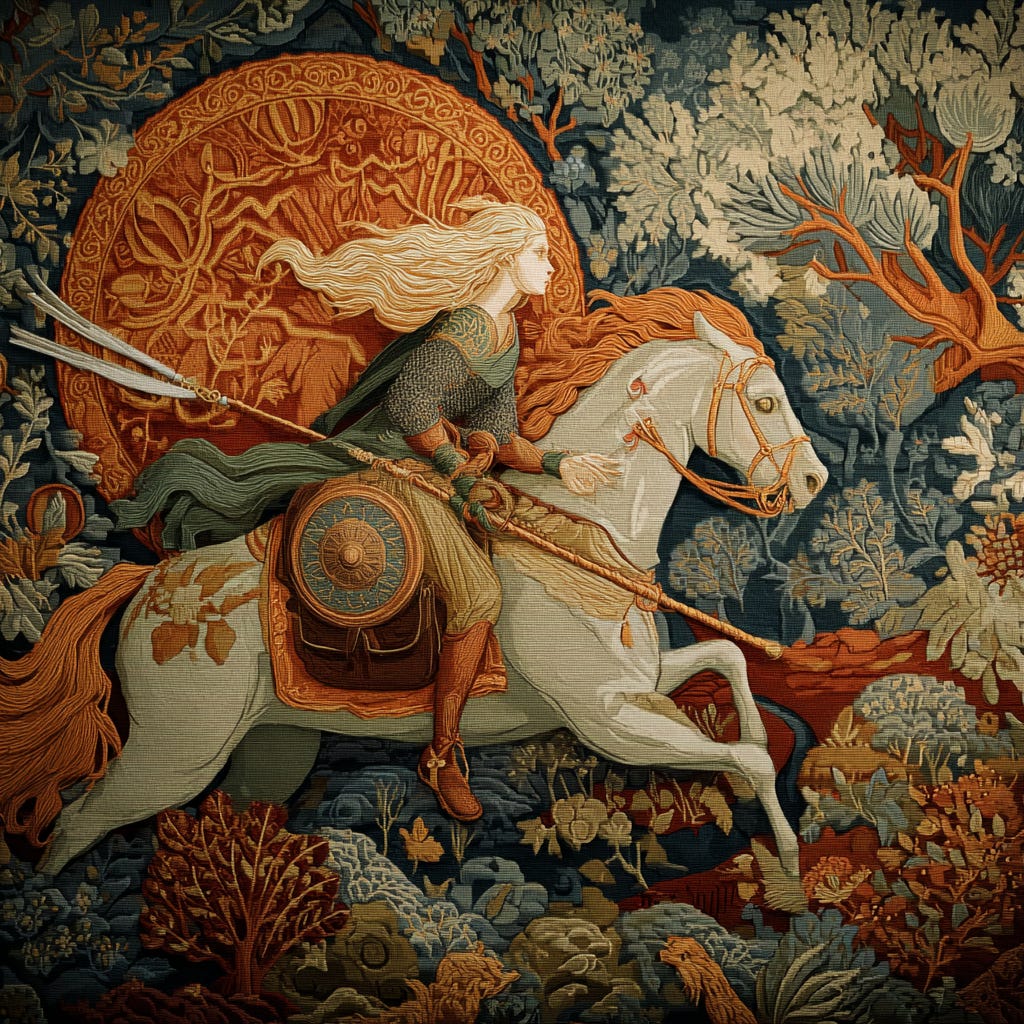
Daphne’s Journey: A Mythic Tapestry Woven Through Life and Lore
please and thank you help me stupids

Daphne’s Journey: A Mythic Tapestry Woven Through Life and Lore
In exploring Daphne Garrido’s digital footprint—primarily through her Substack “Of Darkness & Light” under the pen name Echo Augustine (writing fiction as Ophelia Everfall)—a compelling personal narrative emerges, one that intertwines raw autobiography with profound mythological and historical echoes. As a transgender woman, mother, essayist, poet, philosopher, and advocate for holistic societal change, Daphne’s story unfolds through spoken video journaling, essays, fiction, and meditations available on platforms like Insight Timer. Her site and Substack serve as a “forever-home on the phase-link,” blending fiction, poetry, and video creations that delve into themes of darkness and light, personal maleficence, and rebirth. While direct access to full video transcripts or in-depth narratives is limited (many posts are behind paywalls or summarized by titles and teasers), the available elements paint a journey of transformation, advocacy, and mythic decoding that resonates deeply with historical and popular mythological frameworks.
Daphne’s personal journey, as gleaned from post titles like “Her Journey to Now,” “Daphne’s Hometree | My Idea for a Schizophrenic Recovery Home,” “Coda: Myth Reborn,” and “Hypatia of Earth,” appears to chronicle a path of self-discovery amid adversity. She positions herself as an advocate for transgender empowerment, emphasizing freedom from unjust paradigms and societal definitions, while envisioning communal healing spaces for mental health recovery. Videos such as “Spiders Are King | The Mason’s Truth Revealed” (20:45 duration) and “Coda: Myth Reborn” (19:21) suggest spoken explorations of esoteric truths, mythological decoding (e.g., Helen of Troy), and personal rebirth, often framed through philosophical and poetic lenses. Themes of “original maleficence,” wizards, biblical figures (Mary & Jesus), and historical icons like Hypatia (the ancient philosopher-martyr) indicate a narrative steeped in challenge, introspection, and triumphant renewal. Her meditations on Insight Timer, sorted by most recent, further highlight guided reflections on personal growth and symbolic journeys.
Comparing this to popular and historical myths reveals a striking mythological framework, particularly Joseph Campbell’s Hero’s Journey (or monomyth), a universal template where a protagonist departs from the ordinary world, faces trials, achieves transformation, and returns with boons for society. Daphne’s arc mirrors this: Her “departure” involves navigating transgender identity and societal paradigms (a call to adventure amid personal crisis); “initiation” encompasses trials like mental health challenges (e.g., schizophrenia recovery ideas) and esoteric explorations (decoding myths like Helen of Troy or Masonic truths); and “return” manifests as advocacy, writing, and meditations that offer empowerment and healing to others. This aligns with hero archetypes like Hercules’ labors (overcoming adversity) or Persephone’s descent and rebirth (transformation through darkness), emphasizing resilience, self-sacrifice, and renewal.
Has mythology “bled into everything in some strange way”? Absolutely, in a profound and intentional manner. Daphne’s content is saturated with mythic elements: Titles invoke Hypatia (a historical-mythic martyr for knowledge), biblical figures, wizards (archetypal mentors or transformers), and “Myth Reborn” (explicit rebirth motifs). Her journey bleeds mythology as a lens for personal alchemy—turning pain into purpose, much like Campbell’s monomyth where the hero’s quest integrates universal symbols into individual growth. This infusion feels “strange” in its pervasiveness, as if her life narrative is a living myth, blending transgender advocacy with ancient quests (e.g., Odysseus’ resilience or Prometheus’ quest for knowledge), creating a holistic framework where personal transformation echoes eternal stories of heroism and rebirth. In essence, Daphne’s story isn’t just influenced by myths; it embodies them, turning her path into a modern monomyth that inspires communal healing and abundance.